The Bible is filled with stories and each one can teach us much not only about God and ourselves, but also about human nature. While some of these have been made into movies or dramas, others are never likely to have that occur.
I recently read one such story in 2 Kings 3. This chapter tells about a battle between Moab and the combined forces of Israel and Judah. Moab’s King Mesha had been annually supplying Israel with 100,000 lambs and wool from 100,000 rams. After King Ahab of Israel died, however, Mesha revolted and refused to continue these payments which precipitated the attack by the Israelites.
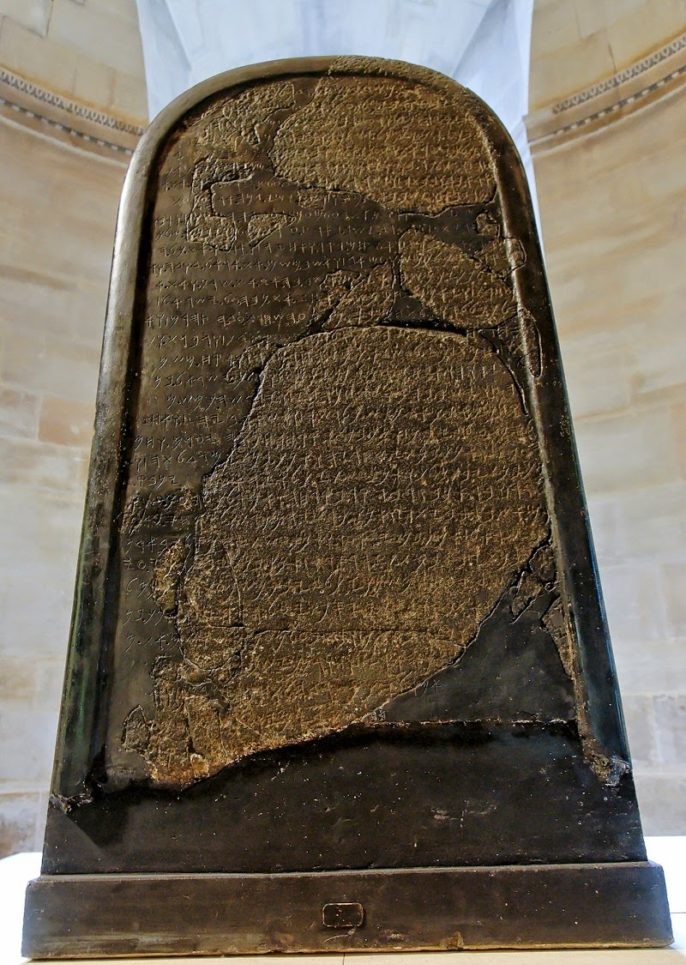
Interestingly enough, this same battle is also described on the Mesha Stele (also known as the Moabite Stone) which a missionary discovered in 1868 in what is now Jordan. This incredible artifact is dated to about 840BC which is near the time of this battle. It includes the name of King Mesha as well as that of his Moabite god, Chemosh, and it tells how the Moabites had been paying tribute to Israel. It is also one of the earliest references to Israel outside the Bible even mentioning Ahab’s father, Omri, and it includes the oldest mention of the Israelite God, Yahweh, outside the Scriptures.
According to the stone, Chemosh helps the Moabites repel the Israelite attack and cast off the Hebrew domination they had been under for several years. The Bible describes the same outcome but goes into more detail explaining that while the Jewish forces had the early advantage and were successfully pushing into Moabite territory, things changed when King Mesha sacrificed his firstborn son on the city wall to earn Chemosh’s favor. Both accounts indicate that the fury against Isreal then became very great and that the Israelite allies then withdrew to their own countries.
It is sobering to think of a man killing his son to save his own neck as well as his nation’s economy, and yet that routinely happened in many cultures. The ESV Archaeology Study Bible describes a location near modern Tunis, Africa where 20,000 children were sacrificed to secure the supposed favor of the gods Tanit and Baal. We are rightly heartbroken to hear of the slaughter of so many innocent children to gain a better standard of living than what the parents thought they might enjoy otherwise. This is another of Satan’s lies.
Ironically, this is the primary selling point for abortion. Although parents are not sacrificing to some deity for success, they are often told that a child would complicate their lives and create financial, social, or professional burdens. Life would be better if their unborn child was “terminated” and tragically, far more than 20,000 have perished in the US. Since 1973, at least 63 million children have been sacrificed to the false belief that life would be better without them. One search engine even states that while millions of abortions have been performed since Roe v. Wade, the number of deaths linked to the procedure remains small, apparently referring to mothers who die while aborting their children and ignoring that a beating heart was stilled and a death occurred in every one of those “procedures.”
Thankfully, Jesus sacrificed His own life to make both our current and eternal lives better. Because He poured out His blood, our sins can be forgiven including abortion, greed, lust, hatred, and all the rest, but we should never presume upon His mercy by persisting in known sin. Jesus commanded His followers to turn away from evil and follow Him. Jesus Himself would have been a prime candidate for abortion having been conceived by a single mother, and the fact that John the Baptist leaped in his mother’s womb when the pregnant Mary entered the room indicates that unborn children are indeed very much alive and even spiritually aware.
May the blindness of former cultures in sacrificing their children open our eyes today. Praying, George