Some of the most popular animals in any zoo are the monkeys. Their curious looks and mischievous behavior often remind us of ways humans sometimes act and interact with each other. Because of this, many have accepted Darwin’s Theory that human beings somehow evolved not only from monkeys, but from primordial lifeless slime over billions of years of time. While mountains evidence refute this theory that has never been proven, it continues to be taught as fact in many schools and colleges and presumed as a given throughout the world.
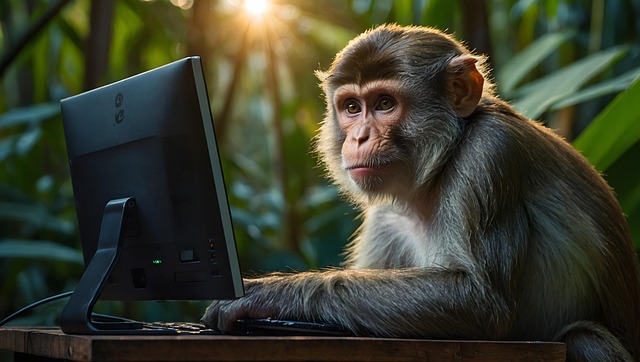
To illustrate how random events with very minute odds of happening, like evolution, could occur, a French mathematician named Émile Borel suggested in 1913 that given enough time and typewriters, millions of monkeys could randomly produce the complete works of William Shakespeare. Various scientists latched onto the idea and have used it to bolster their argument for blind chance as the originator of all life.
Two years ago, however, Sarah Kuta writing in Smithsonian Magazine reported on a thorough study conducted by Stephen Woodcock and Jay Falletta. These two Australian mathematicians put actual numbers to this “Infinite Monkey Theorem” to determine just how likely this preposterous idea was.
Rather than sticking to purely probable numbers, they padded the variables in favor of the monkeys. They assumed that the universe would last a googol years, which is a 1 followed by 100 zeros. They then assumed that the number of chimpanzees would remain constant at current levels of 200,000. They further proposed that chimps could type one key per second throughout an average lifespan of 30 years. Even with all these generous concessions, their statistical probabilities resulted in devastating news for those who champion randomness as the engine of evolution.
The odds that a single chimpanzee would accidentally punch out the word “bananas” was only 5 percent and the chances of him pecking out, “I chimp, therefore I am” are 1 in 10 million billion billion. Obviously, such a five-word phrase with only 23 characters is infinitely less complicated than Hamlet, not to mention all of Shakespeare’s works. This makes the odds so vanishingly small as to not just be improbable, but totally impossible. Even increasing the number of monkeys to infinity and the number of universes to nearly the same, such a fete would never happen according to these researchers.
William Shakespeare produced over 200 plays, sonnets, and poems comprised of over 884,000 words. And while that is a staggering number, it is much less than all of the processes and parts necessary for even the simplest lifeform. The odds of random chance developing a single living cell that functions and reproduces are infinitely smaller than the monkey theorem above and yet it continues to be assumed as unquestioned scientific fact by most institutions.
Just a few glances at God’s amazing creation reveal how life is considerably more complicated than Shakespeare’s writings. Our DNA, for example, holds far more information than several data centers combined, and its capacity to store information compared to its size is the greatest in the universe. Creation Magazine reports that the amount of DNA in a pinhead can hold as much information as a stack of books 500 times greater than the distance from the earth to the moon! Such a complex storage mechanism did not just randomly happen even over billions of years.
In that same Creation issue, current microbiology research reveals unbelievably complex rotary electric motors so small that several hundred can fit side by side on a human hair. Millions of these are spinning in our stomachs right now to power the bacteria that break down our food for energy. Just happened? I don’t think so and neither do statisticians.
While we appreciate the comical antics of monkeys, let’s not consider them our ancestors, but realize an incredibly intelligent God designed and created them, Shakespeare, and us, and let’s worship Him for it Blessings, George