We have been abundantly blessed with wonderful rain this summer! Many years our valley fields are dry and our corn stalks tightly rolled by mid-July. What a blessing to see green everywhere we look!
One of those green crops that has become more common in the Shenandoah Valley are grapevines. Although sparse or even non-existent 50 years ago, vineyards now dot the landscape with their trellised vines.
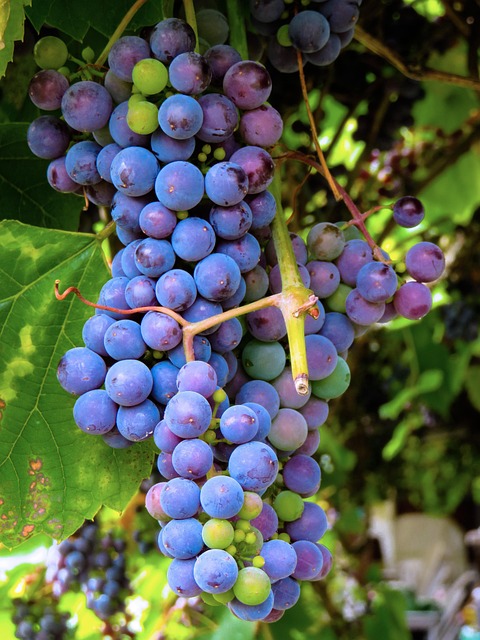
The dramatic increase of grape production in our area should remind Christians of some of Jesus’ last words prior to His crucifixion. In the Upper Room just hours before His arrest, He told His followers, “I am the true vine, and my Father is the gardener. He cuts off every branch in Me that bears no fruit, while every branch that does bear fruit He prunes so that it will be even more fruitful. … You are already clean because of the word I have spoken to you. Remain in me, and I will remain in you. No branch can bear fruit by itself; it must remain in the vine…If a man remains in Me and I in him, he will bear much fruit; apart from Me you can do nothing.” (John 15:1-5)
It is clearly obvious that Jesus wants us to bear fruit for Him! Fruit is a dominant theme throughout the Bible and is found in both the first and last chapters and in many between. The first command God ever gave involved fruit production and that theme is repeated over and over.
But what type of lasting fruit does Jesus want us to produce? Thankfully, the Scriptures give us numerous examples. In the Upper Room that night, Jesus mentioned love no less than 30 times and He specifically commanded His followers to love one another. It’s safe to say that love is certainly spirit-fruit that will last. But in Galatians 5, Paul adds several other varieties of everlasting fruit including joy, peace, patience, kindness, goodness, gentleness, faithfulness and self-control.
While the salvation of individual souls is a primary type of eternal fruit, so also is sanctification, or becoming more like Jesus. Edification, or building others up, as well as glorification are other examples of fruit that lasts. Even when our works and deeds result in no obvious earthly benefit, if God is glorified, eternal fruit is produced! Elsewhere, the Bible mentions the good fruits of righteousness and good works. Our fruitfulness doesn’t save us from our sins, but it should result from our relationship with Jesus, the True Vine.
Just as every grapevine needs four main parts to produce grapes, so we need these same components to produce fruit for Jesus. Grapes draw water and nutrients up through their roots to nourish the plant and it’s necessary for every believer to have deep roots in God’s Word to nurture and sustain us.
Moving upward, each grapevine has a main trunk that could be compared to the disciplines in our schedules that enable fruit production. Regular prayer, Scripture reading, and worship all transport the truth of God’s Word up to the bearing surface of our lives.
Shoots are what the fruit is borne on and these can compare to our jobs, relationships, and areas of service. Just as grape shoots may be lopped off from time to time, our shoots may change in order to maximize our fruitfulness.
The leaves of a grapevine are miniature fruit factories as they take nutrients from the roots, combine them with sunlight, and through the miracle of photosynthesis, they manufacture sugars that become sweet grapes. In our lives, the leaves are actual words and deeds where we take the truths of God’s Word, combine them with the sunlight of His love, and through the miracle of His Holy Spirit, produce good, pleasing, and lasting fruit for Jesus.
The next time you pass a valley vineyard, may it remind you to bear fruit for our True Vine, Jesus, and for our Gardener, His Father. Fruitful Blessings, George